Air cargo agents in this guide handle cargo information, customer enquiries and documentation. Job titles vary: some employers also use “cargo agent” for warehouse work. This record focuses on the administrative/customer-facing function; physical warehouse handling has its own guide and must be checked separately in a combined post.
Educational reference · 27 October 2026. Educational reference — verify current requirements with the relevant authority. This is not a qualification, admission decision or operational publication.
Job-specific employer examples below are separate from the broad sector guides. They are selected evidence, not an application service, a live vacancy feed, worldwide eligibility rules or an assessment of your circumstances.
Specific employer examples
2
Supporting employer context sources
0
Evidence last checked
2026-10-27
Countries / scope represented
Singapore; Switzerland — Geneva/Zurich career context
Legal / licensing applicability
unresolved
Reference status
Educational reference — verify current requirements with the relevant authority.
Related job titles and aliases
Cargo acceptance agent
Titles vary between employers; an alias does not make qualifications or duties interchangeable.
Where employers use this role
Airline cargo handler
Airline or cargo-services company
What the work involves
Check and update shipment information and supporting documents.
Respond to customers and coordinate with cargo/warehouse teams.
Trace discrepancies and maintain records within assigned authority.
Work settings
Cargo office or customer-service counter, working with airline, forwarder and warehouse teams.
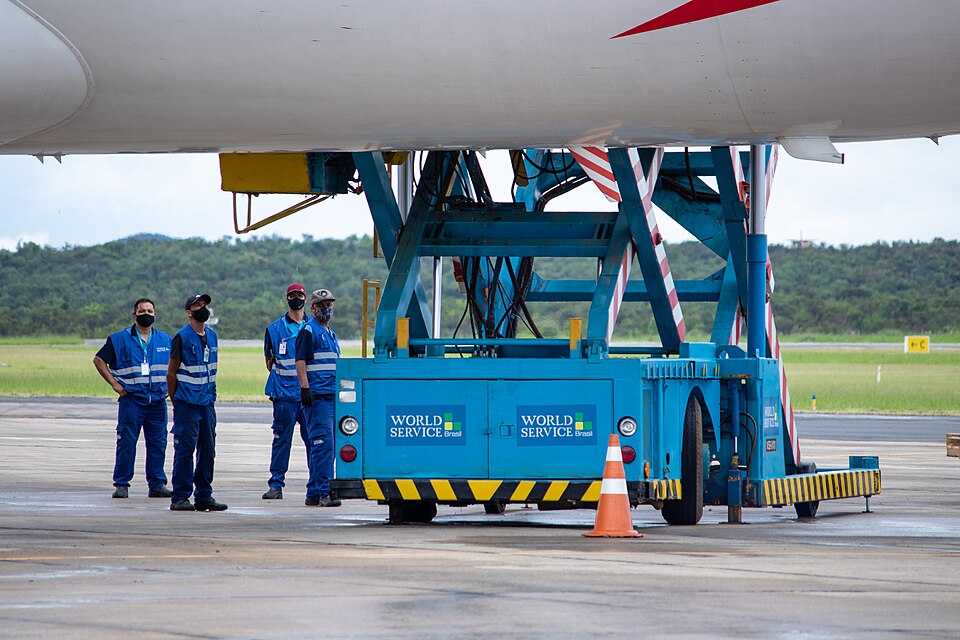
Illustrative photo. Ground personnel stand beside a raised cargo-loading platform beneath a large aircraft. The lift’s supporting structure bridges the height difference between apron level and the aircraft’s cargo access.
Illustrative role/sector context. This does not depict or verify the employers, vacancies, qualifications or countries discussed below.
20201222 EMBARQUE SATELITE AMAZONIA 1 INDIA SAO JOSE DOS CAMPOS SP (50751740606).jpg — Ministério da Ciência, Tecnologia e Inovações from Brasília - DF, Brasil; CC BY 2.0; via Wikimedia Commons. · CC BY 2.0 · Original source · Full credits, source date and changes
Actual employer examples — keep each country and notice separate
Essential, desirable and other conditions retain the author’s source classification. An empty category means no separate requirement was established in the reviewed source, not that employers have no requirements. Historical or closed notices are examples, not current vacancies.
Requirements follow the source headings; preferred items are kept separate. A missing requirement is not evidence that no requirement exists.
Employer essential requirements
English proficiency and excellent computer skills are explicitly essential for the administrative function.
Employer desirable requirements
No separate items established in this reviewed source.
Other stated conditions
No separate items established in this reviewed source.
Duties supported by this example
Shipment-system processing, customer coordination and transport documents.
Specific evergreen role description, not a live vacancy or complete selection specification. Warehouse-agent tasks on the same page are not reassigned to the administrative role.
Official legal, licensing and occupational context
Employer preferences are not automatically law. Official guidance and occupational descriptions are not necessarily binding rules. Each source’s jurisdiction, scope and gaps below remain separate.
Singapore: relevant dangerous-goods functions
CAAS identifies initial/recurrent dangerous-goods training and records for the listed organisations, including cargo ground handlers. Relevant programmes require approval. An office title does not itself confer acceptance authority, and the Singapore framework is not a Swiss or worldwide personal cargo-agent licence.
Dangerous-goods training obligations for the listed organisations and relevant employees.
Limitations
General authority overview; exact employee function and approved employer programme determine applicability. Swiss requirements are not established by this source.
Unresolved research and applicability
Singapore vacancy status is unconfirmed; the Swiss example is a role description rather than a dated vacancy. Swiss local training and access applicability remains unresolved.
Explore a possible entry route
Compare two task lists and mark each duty as customer service, documentation, warehouse work or specialist acceptance. Ask whether one person combines these functions. This prevents choosing a course for a title whose actual work differs from the job you want.
Practise clear written updates, accurate data entry and checking information against its source in a normal study or administrative setting. Record corrections transparently. Learn the meaning of common cargo terms from public introductory resources, without treating a glossary as authority to accept or release a shipment.
For a current opening, clarify induction, systems training and any function-specific assessment before deciding what to study. Distinguish a school qualification from an employer’s preferred experience. A qualification named in one country cannot be assumed equivalent to another country’s school award.
Learning exercises — not proof of professional competence
Create an invented customer-status log with reference, confirmed update, unresolved question and next review time. Deliberately include one missing field and show the request for clarification rather than filling it with a guess.
Write a concise fictional handover from an office team to a warehouse team. Separate what was requested, what was confirmed and what still needs authorised approval. Do not use real cargo manifests, airwaybills or customer personal information.
Preparation prompts — not reported interview questions
Preparation prompt: describe a time when you spotted conflicting paperwork or data. How did you verify the information and keep the customer informed without promising an outcome you could not control?
Ask how office staff are trained for the commodities and functions they handle, who authorises exceptions and how shift handovers work. Do not request access to restricted cargo systems or security procedures.
Progression to investigate
Explore cargo customer-service specialisms, documentation quality or coordination roles after appropriate experience. Dangerous-goods acceptance, brokerage and load control require separate scope and competence checks.
Scope and review limits
Educational requirements guide, not operational instruction or an employment guarantee. Educational reference — verify current requirements with the relevant authority.
Conditions belong to the named employer, post and jurisdiction. They are not worldwide eligibility rules; check the current advertisement and local authority before making training or application decisions.
No customs declaration, dangerous-goods acceptance, cargo-release or loading instruction is supplied.
AI-assisted educational preparation. Source availability and hiring conditions can change. No personal data is collected, no application is sent, and no employment or eligibility outcome is promised.