Aircraft deicing agents perform a specialised ground-service function within an employer’s trained team. The role is separate from clearing snow from airport roads or runways. It is not learned safely from a career guide: aircraft-specific procedures, equipment training and assessed competence must come from the authorised organisation.
Educational reference · 27 October 2026. Educational reference — verify current requirements with the relevant authority. This is not a qualification, admission decision or operational publication.
Job-specific employer examples below are separate from the broad sector guides. They are selected evidence, not an application service, a live vacancy feed, worldwide eligibility rules or an assessment of your circumstances.
Specific employer examples
1
Supporting employer context sources
0
Evidence last checked
2026-10-27
Countries / scope represented
Canada — Quebec
Legal / licensing applicability
checked for stated scope
Reference status
Educational reference — verify current requirements with the relevant authority.
Where employers use this role
Terminal operator
Ground-service contractor
What the work involves
Carry out assigned aircraft de/anti-icing work after relevant training.
Maintain service records and communicate with the team.
Report equipment and environmental concerns through approved arrangements.
Work settings
Outdoor aircraft-servicing areas in winter conditions; seasonal or permanent contracts depend on the employer.
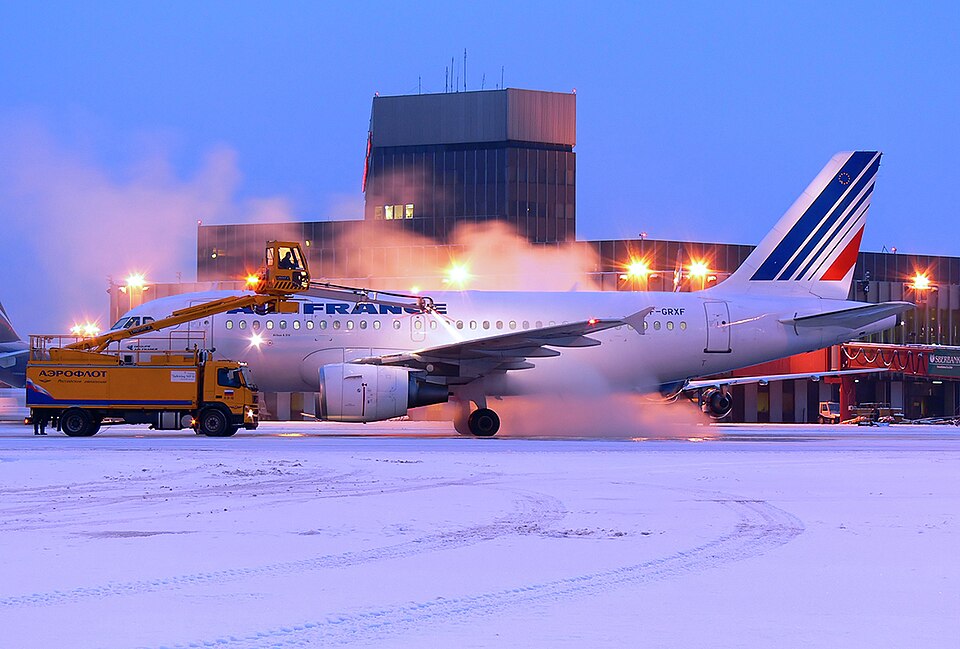
Illustrative photo. Raised ground equipment sprays an airliner while snow covers the apron. The source identifies de-icing at Sheremetyevo, connecting the elevated spray equipment with a documented winter ground-support task.
Illustrative role/sector context. This does not depict or verify the employers, vacancies, qualifications or countries discussed below.
Actual employer examples — keep each country and notice separate
Essential, desirable and other conditions retain the author’s source classification. An empty category means no separate requirement was established in the reviewed source, not that employers have no requirements. Historical or closed notices are examples, not current vacancies.
Requirements follow the source headings; preferred items are kept separate. A missing requirement is not evidence that no requirement exists.
Employer essential requirements
High-school diploma or equivalent; valid Class 5 driving licence.
Communication, attention to detail, safe working and ability to work in prolonged winter conditions.
Employer desirable requirements
Ground-operations/vehicle training, airport/deicing experience, fluid/equipment familiarity and Class 1 or 3 licence.
Other stated conditions
Permanent or seasonal full-time; shifts and required PPE. Seasonal contract ends 30 April, but the year is not specified.
Duties supported by this example
Specialised aircraft treatment, equipment checks, records and reporting.
Quebec employer example. No posting or closure date is displayed; the date-like URL is not treated as a publication date.
Official legal, licensing and occupational context
Employer preferences are not automatically law. Official guidance and occupational descriptions are not necessarily binding rules. Each source’s jurisdiction, scope and gaps below remain separate.
Canada: training within the operator’s ground-icing programme
Transport Canada describes initial and recurrent training/testing tied to the organisation and operator programme. Contractor training must meet the operator’s criteria. A generic course alone does not establish permission to service a particular aircraft. The employer’s driving preference is separate from task competence.
Sections 2.2.4 and 3.3.2.1: organisation-specific training and testing for ground-icing responsibilities.
Limitations
Guidance describing the Canadian ground-icing-program framework; not a worldwide personal licence or standalone training course.
Unresolved research and applicability
One fully verified employer example. Swissport returned 403; Menzies returned an empty ATS template; neither is counted. Exact airport-driving/access conditions require local confirmation.
Explore a possible entry route
Compare the exact function before applying: aircraft treatment, fluid recovery, vehicle maintenance and airfield snow clearance are not interchangeable jobs. Ask which tasks a new recruit performs during training and what is prohibited until assessment. Do not infer competence from a broad “winter operations” title.
Create a prerequisites list from a current local advertisement, with separate columns for credentials already required, training provided after selection and conditions still unclear. Check seasonal dates, transport to unusual shifts and equipment categories. Ask how previous training is recognised rather than buying a certificate on an assumed promise of employment.
Build evidence of following controlled instructions, recording accurately and speaking up when information is unclear in ordinary work or study. Explain your actual contribution and supervision. Do not practise aircraft treatment, radio communication, fluid handling or vehicle manoeuvres outside an authorised training environment.
Learning exercises — not proof of professional competence
Design a fictional training-record tracker with topic, instructor, assessment date, scope and renewal-review field. Use invented names and no claimed qualifications. Show why attendance and demonstrated competence belong in different columns.
Write a short example of noticing an inconsistency in a routine workplace checklist. Explain how you paused, checked with the responsible person and recorded the resolution; do not invent an aviation incident or disclose employer procedures.
Preparation prompts — not reported interview questions
Preparation prompt: how would you respond when a deadline conflicts with an instruction you do not understand? Use a genuine experience showing clarification and respect for your limits, not improvised deicing technique.
Ask about supervised induction, recurrent assessment, weather-related scheduling and how the organisation separates equipment operation from inspection or coordination responsibilities. Confirm who decides when you are authorised for each task.
Progression to investigate
After appropriate experience, investigate team coordination, training support or equipment/environmental specialisms. Each may require separate competence and selection; seasonal service does not guarantee progression.
Scope and review limits
Educational requirements guide, not operational instruction or an employment guarantee. Educational reference — verify current requirements with the relevant authority.
Conditions belong to the named employer, post and jurisdiction. They are not worldwide eligibility rules; check the current advertisement and local authority before making training or application decisions.
No fluid selection, mixture, holdover time, spray technique, aircraft inspection method or operational communication is taught.
AI-assisted educational preparation. Source availability and hiring conditions can change. No personal data is collected, no application is sent, and no employment or eligibility outcome is promised.