ATM simulation pilot — employer requirements guide
On this page — jump to a section
An ATM simulation pilot represents pilots or other positions inside an air traffic control training simulation. This is not a drone pilot job and does not mean flying an aircraft. SAIC and Airservices describe computer-and-voice work supporting instructors and trainees; the role must be distinguished from the controller being trained and the engineer maintaining the simulator. [EMP1, EMP2]
Educational reference · 27 October 2026. Educational reference — verify current requirements with the relevant authority. This is not a qualification, admission decision or operational publication.
Job-specific employer examples below are separate from the broad sector guides. They are selected evidence, not an application service, a live vacancy feed, worldwide eligibility rules or an assessment of your circumstances.
Specific employer examples
2
Supporting employer context sources
0
Evidence last checked
2026-10-27
Countries / scope represented
Australia; United States
Legal / licensing applicability
unresolved
Reference status
Educational reference — verify current requirements with the relevant authority.
Related job titles and aliases
Remote pilot operator in ATC simulation
Simulator support officer
Pseudo-pilot where duties align
Titles vary between employers; an alias does not make qualifications or duties interchangeable.
Where employers use this role
Controller-training contractor
Air navigation service provider training function
What the work involves
Operate simulated aircraft/position responses within the training exercise. [EMP1]
Coordinate with instructors and adapt the simulated scenario to its objectives. [EMP2]
Interpret displayed information and communicate clearly through the simulator system. [EMP1]
Work settings
On-site controller-training simulator
Rostered training-support team
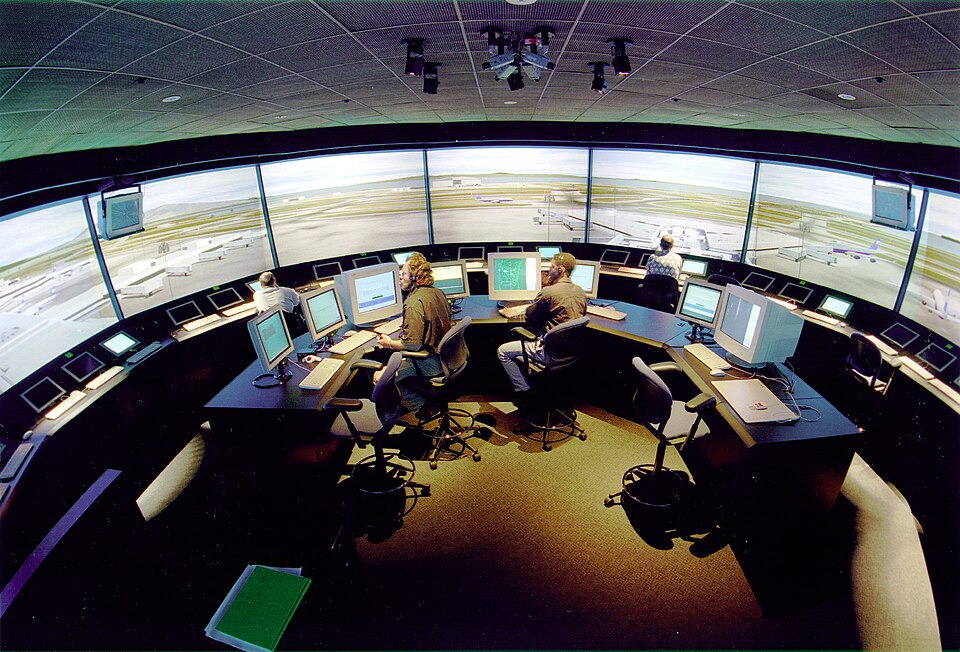
Illustrative photo. A curved arrangement of workstations faces a wraparound simulated airport view. This is a photographed research simulator, illustrating a setting for studying controller work rather than a live operational tower.
Illustrative role/sector context. This does not depict or verify the employers, vacancies, qualifications or countries discussed below.
Actual employer examples — keep each country and notice separate
Essential, desirable and other conditions retain the author’s source classification. An empty category means no separate requirement was established in the reviewed source, not that employers have no requirements. Historical or closed notices are examples, not current vacancies.
The successful applicant will have versus highly regarded/desirable wording; express statement that aviation experience is not required retained.
Employer essential requirements
Information assessment, communication, computer literacy, teamwork and accuracy under pressure.
Australian citizen or permanent resident; stated ASIC/security process.
Employer desirable requirements
Aviation/ATC/simulator/training experience and radiotelephony knowledge.
Other stated conditions
Prior aviation experience not required; training provided; Sydney on-site, rotating seven-day roster.
Duties supported by this example
Simulated pilot/controller functions and scenario support.
One employer and stated role only; this record does not establish current hiring unless explicitly marked active.
Official legal, licensing and occupational context
Employer preferences are not automatically law. Official guidance and occupational descriptions are not necessarily binding rules. Each source’s jurisdiction, scope and gaps below remain separate.
Employer competence versus aircraft-pilot licensing
The FAA facility description confirms a simulation setting. The two employers specify their own training, security and competence arrangements. This evidence does not establish a universal simulation-pilot licence, nor does the word pilot alone establish a requirement for an aircraft or UAS pilot certificate. Check the exact notice and local function. [EMP1, EMP2, REF1]
Official description of pilot-in-the-loop simulation and voice-equipped simulation-pilot positions.
Limitations
Facility context only, not an employment qualification or personal licensing standard; updated 22 April 2025.
Unresolved research and applicability
No independent personal licensing/occupational-standard assessment completed for these simulation-support roles.
Vacancies may close or change after the checked date.
Explore a possible entry route
Search using simulation-specific titles and read the duties before selecting a course. Check whether a vacancy concerns ATC training, a flight-training cockpit simulator, software engineering or UAS operations; these are different jobs despite overlapping words.
Compare required communication, computer and information-processing skills with your own evidence. The two examples allow consideration without previous aviation experience, but this does not remove selection or workplace training. Record any stated certification as employer training unless an authority source establishes otherwise.
Investigate the roster, workplace and training assessment. Ask what supervised learning is provided and which positions you must qualify on. Do not spend money on an aircraft-pilot course solely because an ATC simulation vacancy contains the word pilot.
Learning exercises — not proof of professional competence
Practise an invented non-aviation instruction exercise with a partner: update coloured tokens in a spreadsheet after clear spoken requests. Track corrections and ask for clarification when a request is ambiguous; do not use aviation clearances or claim operational phraseology proficiency.
Write a short reflection on learning unfamiliar software. Show the instructions you followed, the error you noticed and how you verified the correction. A truthful learning log is more useful than presenting hobby gaming as automatic professional competence.
Preparation prompts — not reported interview questions
Preparation prompt: how would you explain the difference between supporting an exercise and being responsible for the trainee’s assessment? Describe how you would establish boundaries with the instructor.
Prepare a real example of remaining accurate when instructions changed. Explain how you checked understanding, acknowledged a mistake and returned to the agreed task without inventing aviation experience.
Progression to investigate
Investigate exercise preparation, senior simulation support or training-technology roles. Becoming an ATCO or a flight instructor requires its own entry, training and authorization process; simulation-support experience does not automatically transfer those privileges.
Scope and review limits
Educational reference — verify current requirements with the relevant authority.
Examples are selected employer conditions, not an exhaustive application checklist or worldwide eligibility rules. Verify the current notice before acting.
Learning exercises are not operational training, assessment or evidence of professional authorization.
AI-assisted educational preparation. Source availability and hiring conditions can change. No personal data is collected, no application is sent, and no employment or eligibility outcome is promised.