Ramp agents support aircraft turnarounds and baggage or cargo movement on the ground. The scope can range from handling bags to operating specialised vehicles after training. A ramp-agent title alone does not establish permission to drive airside, tow aircraft, perform maintenance or undertake every turnaround task.
Educational reference · 27 October 2026. Educational reference — verify current requirements with the relevant authority. This is not a qualification, admission decision or operational publication.
Job-specific employer examples below are separate from the broad sector guides. They are selected evidence, not an application service, a live vacancy feed, worldwide eligibility rules or an assessment of your circumstances.
Specific employer examples
2
Supporting employer context sources
0
Evidence last checked
2026-10-27
Countries / scope represented
Slovenia; Spain
Legal / licensing applicability
checked for stated scope
Reference status
Educational reference — verify current requirements with the relevant authority.
Related job titles and aliases
Baggage handler where duties align
Ramp operative
Titles vary between employers; an alias does not make qualifications or duties interchangeable.
Where employers use this role
Ground-handling contractor
Airport operator
Airline
What the work involves
Load or unload baggage and cargo within assigned responsibilities.
Use designated ground equipment only within the training and permission attached to the job.
Coordinate with other turnaround teams and report conditions outside the assigned scope.
Work settings
Apron and baggage-handling areas, with assignments dependent on local authorisation, equipment and aircraft type.
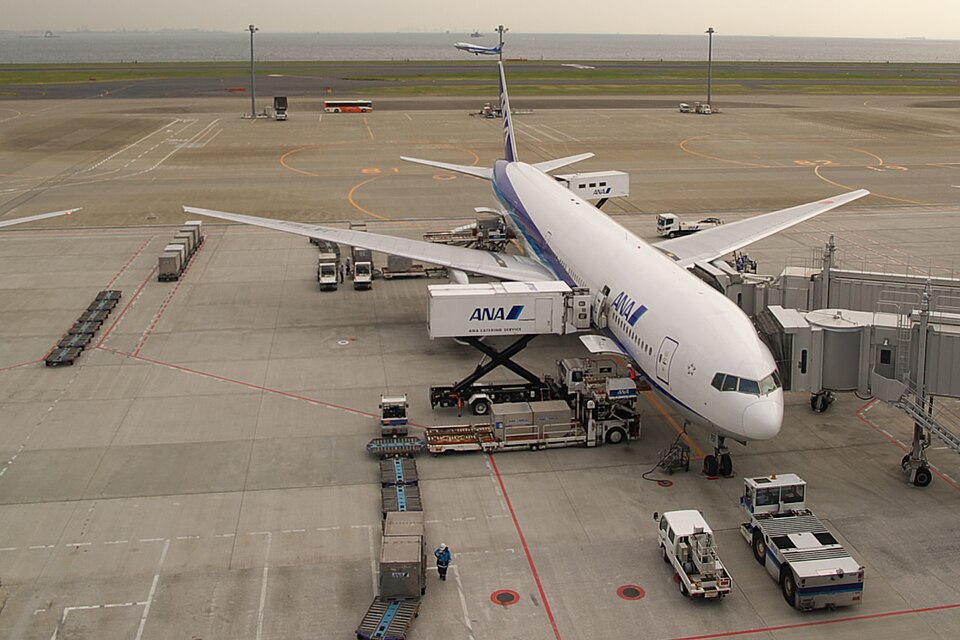
Illustrative photo. An airliner sits among a jet bridge, raised service vehicle, carts and other stand equipment. The elevated viewpoint makes the distribution of ground services around the aircraft visible.
Illustrative role/sector context. This does not depict or verify the employers, vacancies, qualifications or countries discussed below.
Actual employer examples — keep each country and notice separate
Essential, desirable and other conditions retain the author’s source classification. An empty category means no separate requirement was established in the reviewed source, not that employers have no requirements. Historical or closed notices are examples, not current vacancies.
[E054-FRAPORT] Fraport Slovenija — Ground Support Equipment Operator (m/f)
The Ramp section expressly gives priority to licence holders; it does not label the licence mandatory for that role.
Employer essential requirements
No separate items established in this reviewed source.
Employer desirable requirements
Driving licence: the source gives licence holders priority.
Other stated conditions
No separate items established in this reviewed source.
Duties supported by this example
Baggage loading/towing, stairs and ground-vehicle tasks.
Only Ramp criteria apply; the page’s English requirement is stated for Passenger and Operations roles, not Ramp.
Official legal, licensing and occupational context
Employer preferences are not automatically law. Official guidance and occupational descriptions are not necessarily binding rules. Each source’s jurisdiction, scope and gaps below remain separate.
England occupation standard, not a global licence
The aircraft-handling option sets out a learning framework for ground work. Completion of general study is not permission to operate airport equipment. Local rules, airline procedures and employer assessment must be checked for each assigned task.
Passenger-services and aircraft-handling learning reference.
Limitations
The page says revision is in progress and this version remains approved. An English apprenticeship standard is not a Slovenian or Spanish licence or a global recruitment minimum.
Unresolved research and applicability
Two employer examples verified; neither gives a complete local authorisation framework. The Spanish page does not confirm a vacancy deadline.
Explore a possible entry route
Read the task list before judging your fit. Separate manual baggage duties, vehicle operation and specialist aircraft tasks into different columns. Notice that a licence is mandatory in one example but preferred in another; do not turn either employer’s wording into a rule for all airports.
Build evidence of reliability, clear handovers and respectful teamwork through legitimate work or study. A useful account explains how you followed an agreed process, raised a concern and avoided rushing past an uncertainty. You do not need to invent an airport story to demonstrate those habits.
Compare any proposed training with a real vacancy. Ask what the employer teaches after recruitment, which tasks require additional assessment, and whether local permits are arranged through the employer. Do not practise on airport vehicles, approach aircraft or enter restricted areas as an independent learning exercise.
Learning exercises — not proof of professional competence
Create a fictional task-handover sheet for a non-aviation team exercise: assigned activity, owner, status, uncertainty and escalation. Evaluate whether another learner can identify what remains unfinished. Mark the sheet as a learning exercise, not a ramp checklist.
Keep a short evidence log of punctuality, teamwork and reporting mistakes from ordinary work or volunteering. Focus on honest behaviour and lessons learned, rather than claiming operational knowledge from online videos or memorised hand signals.
Preparation prompts — not reported interview questions
Preparation prompt: how would you respond if a colleague asked you to perform an unfamiliar task because time was short? Explain how you would seek the authorised supervisor and avoid presenting guesswork as competence. This is not an operational emergency scenario.
Prepare an example of a clear handover when work was unfinished. Ask the employer about induction, task sign-off, supervision, protective equipment and the actual shift arrangements. Clarify how accommodation questions are handled without assuming that every ramp role has identical physical demands.
Progression to investigate
Potential directions to investigate include specialist equipment work, turnaround coordination or team leadership. Progression depends on training, assessment and available posts; a road driving licence alone does not create airside competence.
Scope and review limits
Educational requirements guide, not operational instruction or an employment guarantee. Educational reference — verify current requirements with the relevant authority.
Conditions belong to the named employer, post and jurisdiction. They are not worldwide eligibility rules; check the current advertisement and local authority before making training or application decisions.
No aircraft towing, loading, marshalling or ground-equipment operating instructions are provided. Follow approved training and site procedures, not this career guide.
AI-assisted educational preparation. Source availability and hiring conditions can change. No personal data is collected, no application is sent, and no employment or eligibility outcome is promised.