Aircraft maintenance careers
Aircraft maintenance combines technical knowledge, careful practical work and accurate records. The field includes mechanical, structural and avionics work, with different job titles and legal privileges across countries. Before choosing a course, distinguish learning to perform work from being authorized to certify particular work. This guide introduces that distinction and helps you investigate a route that matches your interests.
Educational reference · 27 October 2026. Educational reference — verify current requirements with the relevant authority. This is not a qualification, admission decision or operational publication.
Download Aircraft maintenance careers (educational reference PDF)
Global educational core; explicitly labelled jurisdiction examples only
What the work contributes
- Help identify and resolve aircraft or component defects within the worker’s training, supervision and authorisation.
- Support reliable maintenance records and clear handovers, so colleagues can understand what has been completed and what remains unresolved.
- Work with technicians, certifying personnel, planners and other specialists; raising uncertainty is more valuable than guessing.
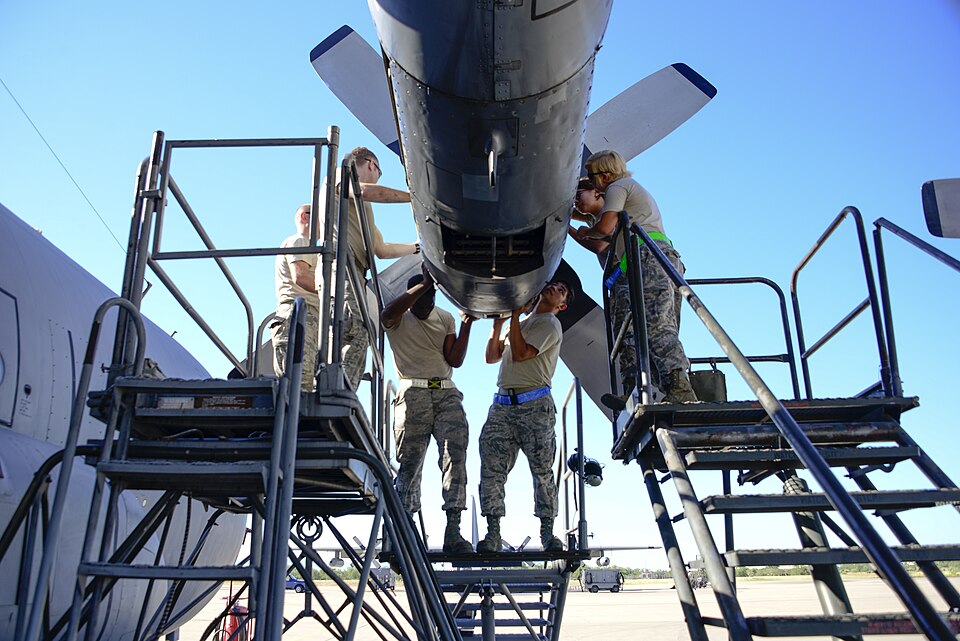
Illustrative photograph — not evidence of local requirements, current operations or employer endorsement.
160831-F-WQ860-001 (29417885011).jpg — U.S. Department of Defense Current Photos Senior Airman Betty Chevalier/355th Fighter Wing; Public-domain declaration on source page; via Wikimedia Commons. · Public-domain declaration on source page · Original source · Full credits, source date and changesAn illustrative working day
Original simplified example only; not a duty schedule or operating procedure.
- Team briefing: A trainee learns about outstanding work and confirms the tasks they may support.
- Assigned work: The trainee assists a qualified colleague, observing how controlled technical information and records shape the task.
- An unexpected finding: The team involves the appropriate specialist rather than asking the trainee to improvise outside their scope.
- Handover: Learning and work records are clarified. Any certification decision belongs to appropriately authorized personnel, not to the trainee merely because they helped.
Role boundaries
Aircraft design, production, maintenance planning and maintenance certification are related but different activities. A person may work in a maintenance organization without holding every certification privilege. Do not assume that a job title or a general engineering degree authorizes release to service. [M1, M3, M4]
A learning task
Fictional example: Sam finds a course titled aviation engineering and another describing a maintenance-certificate route. Sam compares the documented outcome, assessments and practical experience rather than assuming that the more impressive title provides broader legal privileges. Sam asks who records and accepts the experience, and what qualification still remains after the course.
Using a safe everyday object such as a desk lamp, write a non-technical observation note: what you noticed, what you do not know and who should address it. Do not open, repair or test equipment. The aim is clear records and honest uncertainty, not maintenance practice.
Practical next steps
- Choose one technical specialty and identify the country whose certification framework you need to understand.
- Compare the duties of a trainee, a technician and certifying personnel using current official or employer descriptions.
- Ask two providers how their outcome, practical experience and assessment fit the exact certificate or licence route.
- Create a short technical-learning log that records a question, a source, your explanation and what remains unverified.
A typical learning sequence
- 1 Choose a technical interest — Choose a jurisdiction and an initial area of interest: airframes, engines, avionics or another specialty. Explore actual job descriptions before treating a course title as a career route.
- 2 Build foundations you can explain — Build useful foundations in practical mathematics, basic physics, technical reading and clear writing. Practise explaining how you checked an answer, not merely producing one.
- 3 Compare recognized routes — Compare recognised training and supervised-experience routes. In the United States, examine FAA-certificated schools and acceptable practical experience; in the UK, start with the intended Part-66 category.
- 4 Check the practical experience plan — Before enrolling, ask how practical placements, experience records, examinations and fees fit together. A school completion document should not be mistaken for the final licence or certificate.
- 5 Separate learning from authorization — Use the regulator’s current application guidance to plan evidence and assessments. After entry, continue role-specific learning and confirm the limits of every assigned task and certification privilege.
Jurisdiction examples — not worldwide rules
United States · Regulated certificate example
Federal Aviation Administration (FAA)
The FAA Aviation Mechanic certificate can carry Airframe and Powerplant ratings. Applicants must meet applicable eligibility requirements and pass the required knowledge, oral and practical tests; completing a school programme alone does not issue the certificate. [M1]
United Kingdom · Category-specific licence example
UK Civil Aviation Authority (CAA)
A UK Part-66 Aircraft Maintenance Licence application requires relevant knowledge examinations and acceptable evidence of practical maintenance experience. Requirements depend on the category and route; the licence’s release-to-service privileges are category-specific. [M3]
Keep three kinds of information separate
- Regulated requirements
- FAA certificate privileges and UK Part-66 categories are specific. Performing work, holding a qualification and being authorized to certify it are not the same question. Verify the relevant scope and current conditions. [M1, M3, M4]
- Employer conditions
- An employer may require a certificate or previous experience for a vacancy even where that is not a universal regulatory hiring condition. Ask what is required for this position and why. [M1]
- Typical preparation
- Technical curiosity, practical mathematics, careful reading and clear records can help you explore. These do not replace required training, examinations, experience or authorization.
Sources and jurisdiction
- [M1] Become an Aviation Mechanic — United States. Ratings, tests, supervised work, return-to-service distinction and employer certificate policies.
- [M2] Experience Requirements to Become an Aircraft Mechanic — United States. Certificated-school and practical-experience routes; school graduation permits testing subject to other eligibility conditions.
- [M3] Apply for a UK Part 66 Aircraft Maintenance Licence — United Kingdom. Knowledge examinations, experience evidence and category-dependent licensing requirements.
- [M4] UK Part-66 general guidance — United Kingdom. Distinction between licence validity and recent experience needed to exercise certification privileges.