An airport emergency-planning officer develops organizational preparedness: plans, exercises, liaison and improvement records. This is distinct from being a firefighter or automatically commanding an incident. The examples include a coordinator and a more senior continuity manager, so their experience thresholds are not interchangeable. [EMP1, EMP2]
Educational reference · 27 October 2026. Educational reference — verify current requirements with the relevant authority. This is not a qualification, admission decision or operational publication.
Job-specific employer examples below are separate from the broad sector guides. They are selected evidence, not an application service, a live vacancy feed, worldwide eligibility rules or an assessment of your circumstances.
Specific employer examples
2
Supporting employer context sources
0
Evidence last checked
2026-10-27
Countries / scope represented
Singapore; United States — California
Legal / licensing applicability
unresolved
Reference status
Educational reference — verify current requirements with the relevant authority.
Where employers use this role
Airport operator
What the work involves
Coordinate plan maintenance and preparedness activities. [EMP1, EMP2]
Organize exercises, training and multi-organization liaison. [EMP1, EMP2]
Track learning and improvement after exercises or events. [EMP1]
Work settings
Airport planning office and exercise settings
Occasional out-of-hours attendance according to the role
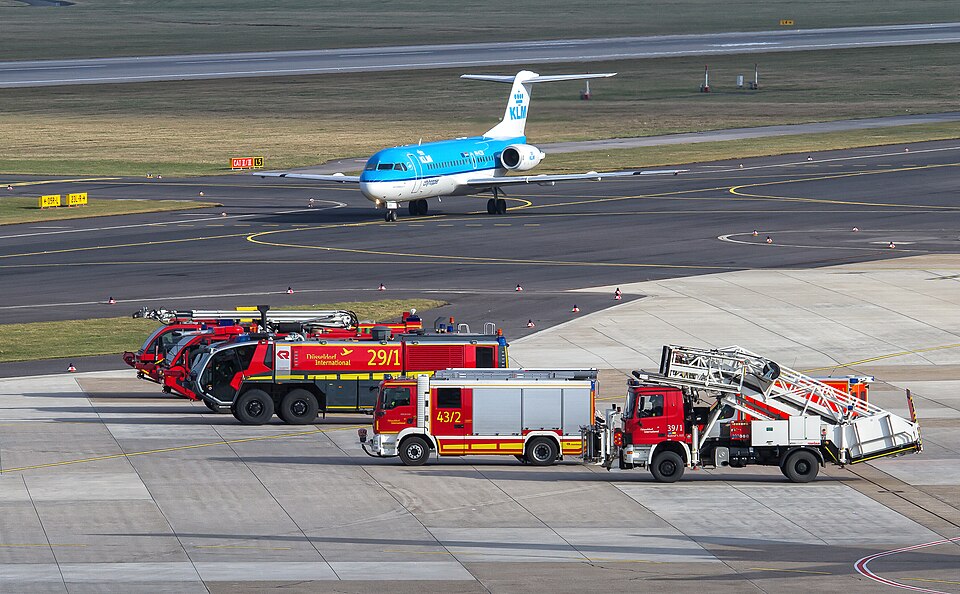
Illustrative photo. Several airport fire and rescue vehicles are parked near an airliner and airfield movement areas. Airport rescue and firefighting teams use specialized vehicles for aircraft emergencies; this lineup introduces the equipment without demonstrating a live response or establishing operational readiness.
Illustrative role/sector context. This does not depict or verify the employers, vacancies, qualifications or countries discussed below.
Actual employer examples — keep each country and notice separate
Essential, desirable and other conditions retain the author’s source classification. An empty category means no separate requirement was established in the reviewed source, not that employers have no requirements. Historical or closed notices are examples, not current vacancies.
[EMP1] City and County of San Francisco / San Francisco International Airport — Airport Emergency Planning Coordinator 9247, REF49682G
Mandatory wording or requirements heading; preferred wording kept separate.
Employer essential requirements
Bachelor’s degree and at least seven years relevant crisis/business-continuity experience in a large organization.
Cross-functional leadership, stakeholder communication and prioritization capability.
Employer desirable requirements
No separate items established in this reviewed source.
Other stated conditions
Senior permanent role; no closing date is stated.
Duties supported by this example
Continuity planning and exercise readiness.
One employer and stated role only; this record does not establish current hiring unless explicitly marked active.
Official legal, licensing and occupational context
Employer preferences are not automatically law. Official guidance and occupational descriptions are not necessarily binding rules. Each source’s jurisdiction, scope and gaps below remain separate.
US airport-operator obligations
FAA identifies emergency planning among applicable airport-operator responsibilities. An organization’s obligation to maintain a plan does not establish a universal degree or personal licence for every employee contributing to it. [REG1]
Airport-operator certification scope and reference to airport emergency plans under 139.325.
Limitations
Overview is not the complete current planning rule or a personal qualification standard; Singapore law was not reviewed.
Unresolved research and applicability
SFO vacancy status cannot be confirmed from its open-ended closing wording.
Complete US and Singapore legal applicability and site-specific responsibilities remain unresolved.
Explore a possible entry route
Compare planning, response and business continuity before choosing a course. Identify whether the vacancy expects coordination, specialist plan ownership or management experience. Treat the Changi manager example as a senior comparison, not a beginner entry threshold.
Build a dated requirements matrix distinguishing education, experience, access checks and preferred training. If a notice allows substitutions, preserve its limits rather than assuming that any airport experience replaces all education or emergency-management experience.
Develop meeting, documentation and project-follow-up skills in safe settings. Evaluate further training for recognized assessment and employer relevance; a certificate from a short course does not appoint you to an airport response function.
Learning exercises — not proof of professional competence
Plan a fictional tabletop discussion about rescheduling a school exhibition. Define learning objectives, participant roles and how feedback will be collected, without writing an airport emergency plan or response sequence.
Create a simple improvement register for that discussion: issue, evidence, owner and review date. Mark a suggested action as proposed until the responsible person accepts it; do not label a document complete merely because it exists.
Preparation prompts — not reported interview questions
Preparation prompt, not a reported interview question: how would you keep several organizations engaged in a planning project when their priorities differ? Use a genuine collaboration example.
Explain the difference between conducting an exercise, recording attendance and demonstrating that an identified weakness was addressed. Avoid claiming that your fictional activity validates operational readiness.
Progression to investigate
Investigate resilience, continuity leadership or broader airport-management work after relevant experience. These are possible directions to research, not guaranteed promotion or automatic incident-command authority.
Scope and review limits
Educational reference — verify current requirements with the relevant authority.
Examples are selected employer conditions, not an exhaustive application checklist or worldwide eligibility rules. Verify the current notice before acting.
Learning exercises are not operational training, assessment or evidence of professional authorization.
No emergency response procedures, screening methods, investigative tactics or personal medical eligibility advice are provided.
AI-assisted educational preparation. Source availability and hiring conditions can change. No personal data is collected, no application is sent, and no employment or eligibility outcome is promised.