Airport rescue firefighters maintain readiness for airfield emergencies and perform authorized response duties. Civilian aviation rescue and military firefighting share some subject areas but have different service obligations and appointment systems. Neither is the same job as a rescue coordination-centre officer. [EMP1, EMP2]
Educational reference · 27 October 2026. Educational reference — verify current requirements with the relevant authority. This is not a qualification, admission decision or operational publication.
Job-specific employer examples below are separate from the broad sector guides. They are selected evidence, not an application service, a live vacancy feed, worldwide eligibility rules or an assessment of your circumstances.
Specific employer examples
2
Supporting employer context sources
0
Evidence last checked
2026-10-27
Countries / scope represented
Australia
Legal / licensing applicability
unresolved
Reference status
Educational reference — verify current requirements with the relevant authority.
Maintain readiness through training and assigned equipment work. [EMP1, EMP2]
Provide authorized emergency response as part of a trained team. [EMP1, EMP2]
Work within the relevant civilian or military service structure. [EMP1, EMP2]
Work settings
Airport fire station
Military air base in the second example
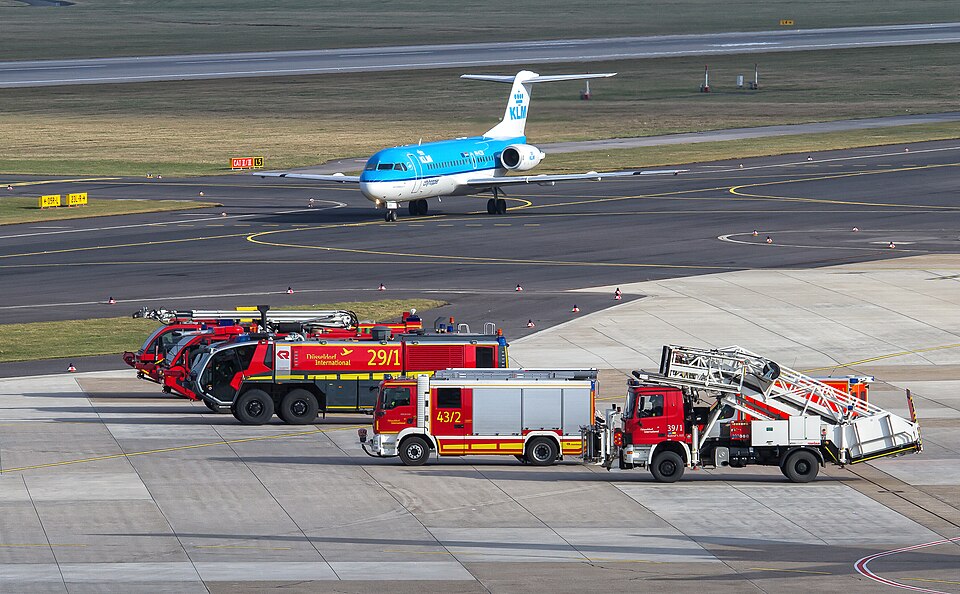
Illustrative photo. Several airport fire and rescue vehicles are parked near an airliner and airfield movement areas. Airport rescue and firefighting teams use specialized vehicles for aircraft emergencies; this lineup introduces the equipment without demonstrating a live response or establishing operational readiness.
Illustrative role/sector context. This does not depict or verify the employers, vacancies, qualifications or countries discussed below.
Actual employer examples — keep each country and notice separate
Essential, desirable and other conditions retain the author’s source classification. An empty category means no separate requirement was established in the reviewed source, not that employers have no requirements. Historical or closed notices are examples, not current vacancies.
[EMP1] Airservices Australia — Aviation Rescue Fire Fighter
Mandatory wording or requirements heading; preferred wording kept separate.
Employer essential requirements
Year 10 English/mathematics or stated equivalent route; qualifying C Class driver licence.
Meet military entry, security, medical and physical requirements.
Employer desirable requirements
No separate items established in this reviewed source.
Other stated conditions
No prior experience required; military training and minimum service commitment apply.
Duties supported by this example
Aerodrome and structural firefighting.
One employer and stated role only; this record does not establish current hiring unless explicitly marked active.
Official legal, licensing and occupational context
Employer preferences are not automatically law. Official guidance and occupational descriptions are not necessarily binding rules. Each source’s jurisdiction, scope and gaps below remain separate.
Australian civilian aerodrome services
CASA’s Part 139 overview includes the civilian rescue/firefighting service framework. That organizational framework should not be mistaken for one worldwide personal licence or automatically applied to the RAAF example. [REG1]
Aerodrome framework including aviation rescue and firefighting services.
Limitations
Overview only; service framework and individual role requirements must be verified. Proposed changes are not treated as already effective.
Unresolved research and applicability
Airservices page sections disagree on citizenship wording and training length; no duration is asserted here.
Full current civilian and military legal applicability and credential equivalence remain unresolved.
Explore a possible entry route
Choose civilian airport service or military service before comparing entry routes. The nature of the employer, posting commitments and training system matters as much as the title. Identify the actual intake and its dates, not only an evergreen careers page.
List the credentials required before selection and those required before starting work. Where a source contradicts itself, retain the uncertainty and seek official clarification rather than choosing the easier version. Do not infer medical suitability from a self-made exercise.
Develop ordinary teamwork, reliable record keeping and a realistic understanding of shift commitments. Physical preparation should follow appropriate personal professional advice; this guide does not provide fitness tests, rescue techniques or emergency equipment instructions.
Learning exercises — not proof of professional competence
Make a fictional training-attendance register and identify missing dates or approvals. Explain why an unchecked record is not evidence that someone completed a course. Do not use actual personnel data.
Prepare a comparison of civilian and military recruitment commitments using public pages. Include location, training responsibility and unanswered questions; avoid claiming equivalence of qualifications or authorization between the two systems.
Preparation prompts — not reported interview questions
Preparation prompt, not a real interview question: describe a time you supported a team through repetitive preparation work, not only an exciting event. What made your contribution dependable?
How would you respond to a gap in a training record without assuming either that the task was completed or that a colleague was at fault? Keep the example administrative and non-operational.
Progression to investigate
Investigate instruction, crew leadership or service-management roles after appropriate experience and qualification. A move into SAR coordination or another emergency service requires a separate check of its entry and competence requirements.
Scope and review limits
Educational reference — verify current requirements with the relevant authority.
Examples are selected employer conditions, not an exhaustive application checklist or worldwide eligibility rules. Verify the current notice before acting.
Learning exercises are not operational training, assessment or evidence of professional authorization.
No emergency response procedures, screening methods, investigative tactics or personal medical eligibility advice are provided.
AI-assisted educational preparation. Source availability and hiring conditions can change. No personal data is collected, no application is sent, and no employment or eligibility outcome is promised.