Aviation radio spectrum engineer — employer requirements guide
On this page — jump to a section
An aviation spectrum engineer helps protect the radio resources needed by aviation systems. The emphasis is compatibility, frequency coordination, records and interference analysis—not routine maintenance of every radio or radar. The verified example supports FAA spectrum work through a contractor; it is not a universal entry route or a permission to transmit.
Educational reference · 27 October 2026. Educational reference — verify current requirements with the relevant authority. This is not a qualification, admission decision or operational publication.
Job-specific employer examples below are separate from the broad sector guides. They are selected evidence, not an application service, a live vacancy feed, worldwide eligibility rules or an assessment of your circumstances.
Specific employer examples
1
Supporting employer context sources
0
Evidence last checked
2026-10-27
Countries / scope represented
United States
Legal / licensing applicability
checked for stated scope
Reference status
Educational reference — verify current requirements with the relevant authority.
Related job titles and aliases
Aeronautical spectrum engineer
Aviation RF spectrum specialist
Titles vary between employers; an alias does not make qualifications or duties interchangeable.
Where employers use this role
Air navigation service provider
Aviation regulator or government technical office
Specialist engineering contractor
What the work involves
Review technical information for frequency coordination.
Analyse compatibility and potential interference.
Maintain accurate technical records.
Coordinate findings with engineering and regulatory stakeholders.
Work settings
Engineering offices and specialist technical teams; some roles include investigations or site work.
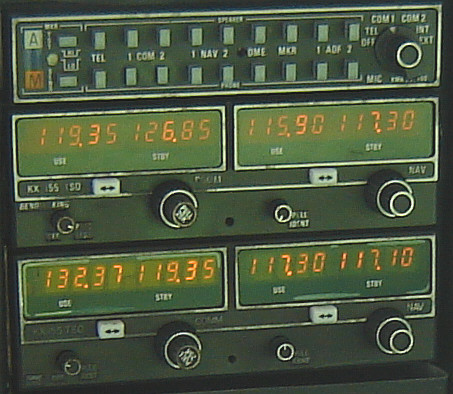
Illustrative photo. Two paired radio units sit below an audio-control panel. Separate displays and tuning controls show how cockpit communication and navigation equipment can be grouped together.
Illustrative role/sector context. This does not depict or verify the employers, vacancies, qualifications or countries discussed below.
Actual employer examples — keep each country and notice separate
Essential, desirable and other conditions retain the author’s source classification. An empty category means no separate requirement was established in the reviewed source, not that employers have no requirements. Historical or closed notices are examples, not current vacancies.
[EMP1] Leidos — Spectrum Engineer / Radio Frequency Engineer, R-00190917
Basic Qualifications versus Preferred Qualifications headings.
Employer essential requirements
Electrical engineering bachelor degree, formal spectrum-management course or equivalent military spectrum experience.
At least two years relevant RF/spectrum experience; office-software proficiency and ability to learn FAA systems.
US citizenship; Secret clearance or ability to qualify.
Employer desirable requirements
Aviation RF theory, compatibility/data tools, interference assessment and federal spectrum-policy knowledge.
Other stated conditions
Must be able to attend Washington, DC as needed. Employer page explicitly says no longer active.
Duties supported by this example
FAA frequency-assignment support, compatibility analysis and technical-data validation.
One employer and role, not worldwide eligibility. Closed or undated examples do not establish current hiring.
Official legal, licensing and occupational context
Employer preferences are not automatically law. Official guidance and occupational descriptions are not necessarily binding rules. Each source’s jurisdiction, scope and gaps below remain separate.
United States — agency spectrum authority
FAA’s spectrum office obtains NTIA authorisations for specified agency facilities. An engineering qualification or job offer does not itself permit radio transmission or frequency assignment.
Named employer vacancy
Degree/training alternatives, citizenship and security conditions are this employer’s requirements. They are not worldwide legal minima for aviation spectrum careers.
FAA office responsibilities include obtaining NTIA authorisation for agency facilities.
Limitations
Official function description, not a personal licensing guide or permission to transmit.
Unresolved research and applicability
Only one specific employer example is verified. This guide does not consolidate NTIA/FCC rules or determine individual security eligibility.
Explore a possible entry route
Build foundations in radio-frequency concepts, mathematics, data quality and technical writing. Separate learning the science from being authorised to apply it to aviation facilities. A general telecommunications background may be relevant, but the actual employer decides what experience meets its criteria.
Compare whether a vacancy concerns spectrum policy, coordination or detailed engineering analysis. These functions interact, but they do not necessarily use the same entry qualifications or daily work pattern.
For a first role, investigate graduate RF engineering and supervised technical routes instead of assuming this experienced contractor advert is the only path. Keep all alternatives and equivalence wording visible when comparing vacancies.
Ask how aviation-specific knowledge, approved analysis tools and governance are taught. Before buying training, confirm that the intended employer recognises it; do not confuse a course completion certificate with spectrum authorisation.
Learning exercises — not proof of professional competence
Create an invented equipment-data register and check it for missing units, inconsistent identifiers and unclear provenance. Explain the corrections in a change log. Do not populate it with real aviation frequencies, sensitive site details or unauthorised measurements.
Write a plain-language explanation of interference risk using a harmless everyday analogy. State which assumptions would need professional checking; do not provide transmitter setup, jamming methods or operational mitigation instructions.
Use a classroom mathematical dataset to demonstrate reproducibility: inputs, units, method, checks and limitations. The goal is disciplined reasoning, not producing a real frequency assignment or interference assessment.
Preparation prompts — not reported interview questions
Prepare an example of discovering poor input data before it affected a decision. Explain how you checked the issue and communicated it without overstating your authority.
Ask what part of the process the engineer owns, which decisions require approval, and how national rules and international coordination interact. Clarify any clearance and location conditions directly in the current advertisement.
Progression to investigate
Directions to explore include spectrum coordination, RF systems assurance, technical policy or engineering project work. Moving into these areas depends on further experience and the applicable authority’s arrangements.
Scope and review limits
Educational requirements guide, not operational instructions, professional approval or an employment guarantee. Educational reference — verify current requirements with the relevant authority.
Examples are selective and date-specific. Check the full current vacancy and competent authority before choosing paid training or assessing eligibility. No personal medical, nationality or immigration assessment is made here.
AI-assisted educational preparation. Source availability and hiring conditions can change. No personal data is collected, no application is sent, and no employment or eligibility outcome is promised.