Cargo loadmasters oversee aircraft cargo-loading activity within an operator’s assigned responsibilities. They can travel with aircraft or support loading at stations. This is distinct from a central load controller who may produce loading information remotely; titles and shared tasks vary. Neither title alone grants authority for a particular aircraft or operator.
Educational reference · 27 October 2026. Educational reference — verify current requirements with the relevant authority. This is not a qualification, admission decision or operational publication.
Job-specific employer examples below are separate from the broad sector guides. They are selected evidence, not an application service, a live vacancy feed, worldwide eligibility rules or an assessment of your circumstances.
Specific employer examples
2
Supporting employer context sources
0
Evidence last checked
2026-10-27
Countries / scope represented
United Kingdom — London Stansted; United States — Orlando-based employer; home-based role
Legal / licensing applicability
checked for stated scope
Reference status
Educational reference — verify current requirements with the relevant authority.
Where employers use this role
Cargo airline
Charter/cargo aircraft operator
What the work involves
Oversee assigned loading activity and coordinate with ground handlers.
Review loading information and communicate discrepancies to responsible personnel.
Maintain required records within the operator’s training and authorisation.
Work settings
Aircraft-side loading operations and travel to multiple stations; home-base and roster arrangements are employer-specific.
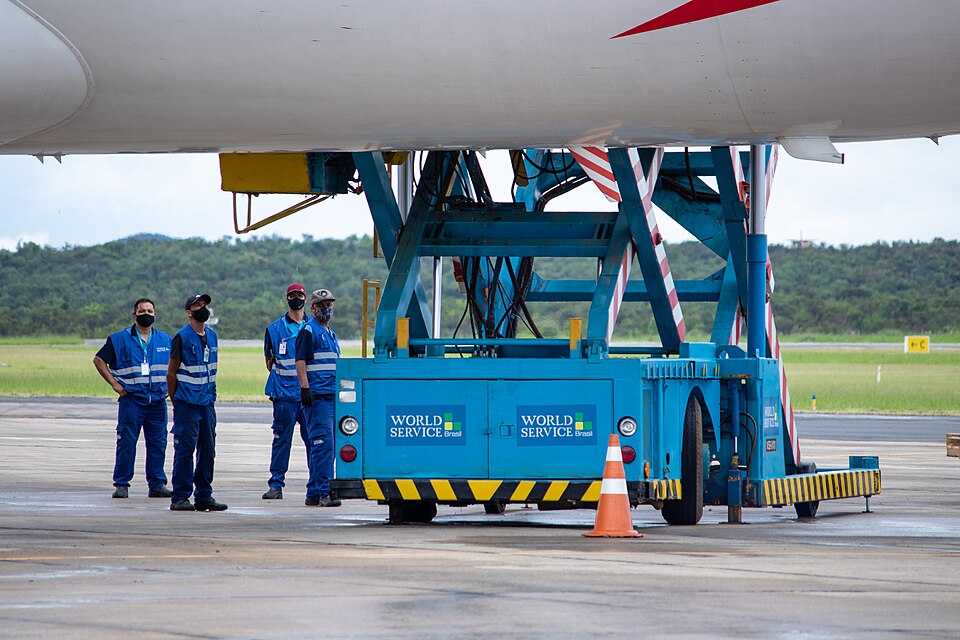
Illustrative photo. Ground personnel stand beside a raised cargo-loading platform beneath a large aircraft. The lift’s supporting structure bridges the height difference between apron level and the aircraft’s cargo access.
Illustrative role/sector context. This does not depict or verify the employers, vacancies, qualifications or countries discussed below.
20201222 EMBARQUE SATELITE AMAZONIA 1 INDIA SAO JOSE DOS CAMPOS SP (50751740606).jpg — Ministério da Ciência, Tecnologia e Inovações from Brasília - DF, Brasil; CC BY 2.0; via Wikimedia Commons. · CC BY 2.0 · Original source · Full credits, source date and changes
Actual employer examples — keep each country and notice separate
Essential, desirable and other conditions retain the author’s source classification. An empty category means no separate requirement was established in the reviewed source, not that employers have no requirements. Historical or closed notices are examples, not current vacancies.
United States — Orlando-based employer; home-based role
Source type
employer vacancy
Advert / source status
unknown
Posting date
Not stated / not established
Closing date
Not stated / not established
Checked date
2026-10-27
Classification basis
Explicit preferred qualifications remain preferred. Heavy-jet experience appears with inconsistent classification, so its essential/desirable status is left unresolved.
Employer essential requirements
Mathematical/written communication, analytical judgment and computer capability, including weight-and-balance software.
Domestic/international travel and valid unrestricted passport with ability to enter/exit the US.
Employer desirable requirements
Previous/current widebody loadmaster qualification, freight-build/load-planning and hazmat experience.
Other stated conditions
Heavy-jet experience is preferred under Qualifications but also listed under Competencies; confirm its selection status.
Duties supported by this example
Cargo-loading oversight and operational documentation.
Undated employer posting. Loading oversight is not staff line-management: the advert separately states no supervisory responsibilities.
Requirements follow the source headings; preferred items are kept separate. A missing requirement is not evidence that no requirement exists.
Source version: Historical 2025 recruitment; exact posting/closing dates not supplied.
Employer essential requirements
Three years’ cargo ground-handling experience with narrow- and widebody aircraft.
Computer literacy, extensive travel/roster flexibility and ability to meet the stated UK work and US crew-visa conditions.
Employer desirable requirements
Previous loadmaster, flight-manager or dispatcher work; IGOM/IOSA and dangerous-goods experience.
Other stated conditions
BPSS screening; sponsorship is mentioned as potentially available, not guaranteed.
Duties supported by this example
Ground-handler coordination, loading-information checks and reporting.
Explicitly closed historical advert with a February 2025 interview reference. Not evidence of current hiring.
Official legal, licensing and occupational context
Employer preferences are not automatically law. Official guidance and occupational descriptions are not necessarily binding rules. Each source’s jurisdiction, scope and gaps below remain separate.
United States: covered Part 121 functions
Subject to the rule’s specified exceptions, covered personnel require the operator’s approved initial/recurrent hazardous-materials training for the addressed functions. This is separate from a preferred prior loadmaster qualification.
United Kingdom: operator dangerous-goods functions
CAA guidance requires relevant training and assessment before assigned functions, recurrent assessment and records. Generic learning must be supplemented for operator-specific procedures; a change of function requires competence verification.
[O063-FAA] US Electronic Code of Federal Regulations
Hazardous-materials training for covered Part 121 functions.
Limitations
eCFR title 14 displayed as current to 22 October 2026; authoritative but unofficial compilation. Applicable person/functions and exceptions matter; not a worldwide loadmaster licence.
Operator staff with relevant cargo, loading and other dangerous-goods responsibilities.
Limitations
Role-specific guidance; the full operator training and authorisation framework must also be checked.
Unresolved research and applicability
Two employer examples verified, including one explicitly closed historical advert. Current opportunities, aircraft-specific authorisations and individual travel eligibility remain unconfirmed.
Explore a possible entry route
Compare the job’s oversight, documentation, travel and equipment responsibilities. Ask how it interfaces with load control, the commander and ground handlers. Do not assume a combined title means that one employee makes every loading or flight-release decision.
Check whether the opening is experienced recruitment or a structured development route. List genuine cargo or coordination experience and gaps against that exact post. Prior ground handling can be relevant without automatically qualifying someone for a different aircraft or operator.
Ask how aircraft/operator training, supervised practice and assessment are arranged. Immigration, travel-document and screening conditions belong to the specific employment situation; this guide cannot decide an individual’s eligibility or promise sponsorship.
Learning exercises — not proof of professional competence
Write an invented information-handover note with confirmed facts, discrepancies and the responsible decision owner. Use no aircraft weights, balance calculations, loading diagrams or restraint instructions.
Prepare a real example of coordinating teams with different responsibilities. Show how you confirmed understanding and respected another person’s authority rather than claiming technical decisions outside your experience.
Preparation prompts — not reported interview questions
Preparation prompt: how do you challenge inconsistent information respectfully when several teams are waiting? Describe verification and escalation, not an improvised loading solution.
Ask about roster expectations, training recognition, competence assessment and the difference between leading a task and managing employees. Do not request confidential operator manuals.
Progression to investigate
With further competence and selection, investigate training support, station coordination or specialist cargo roles. A past aircraft qualification does not guarantee transfer or progression.
Scope and review limits
Educational requirements guide, not operational instruction or an employment guarantee. Educational reference — verify current requirements with the relevant authority.
Conditions belong to the named employer, post and jurisdiction. They are not worldwide eligibility rules; check the current advertisement and local authority before making training or application decisions.
No weight-and-balance calculation, load plan, restraint method, aircraft servicing or operational clearance advice is supplied.
AI-assisted educational preparation. Source availability and hiring conditions can change. No personal data is collected, no application is sent, and no employment or eligibility outcome is promised.