Cargo warehouse operatives handle the physical flow of freight and associated records. The reviewed role is in an off-airport facility, demonstrating that aviation logistics is not confined to airport employment. It differs from an office cargo agent, even where employers use a combined title.
Educational reference · 27 October 2026. Educational reference — verify current requirements with the relevant authority. This is not a qualification, admission decision or operational publication.
Job-specific employer examples below are separate from the broad sector guides. They are selected evidence, not an application service, a live vacancy feed, worldwide eligibility rules or an assessment of your circumstances.
Specific employer examples
1
Supporting employer context sources
0
Evidence last checked
2026-10-27
Countries / scope represented
Australia — Banksmeadow, New South Wales
Legal / licensing applicability
checked for stated scope
Reference status
Educational reference — verify current requirements with the relevant authority.
Where employers use this role
Cargo handling company
Logistics/warehouse provider
What the work involves
Receive, move and prepare freight within the assigned warehouse workflow.
Use authorised equipment and record shipment movements.
Report cargo or documentation discrepancies to the responsible team.
Work settings
Cargo warehouse or offsite air-freight facility; manual activity and rostered shifts depend on the post.
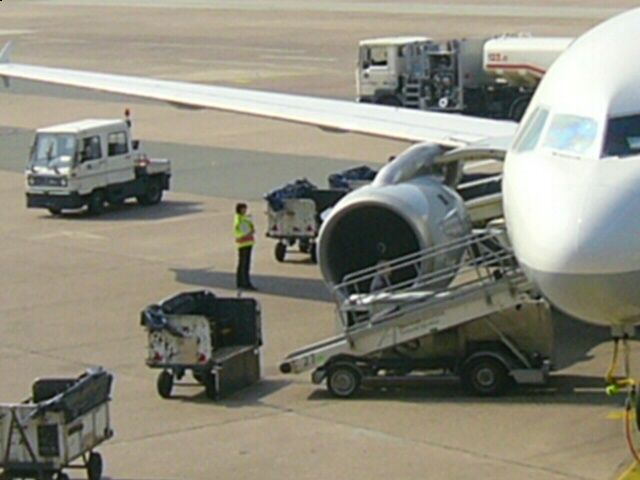
Illustrative photo. A raised loading platform and container dollies stand beside an airliner. Containers bring bags or freight together for transfer between ground equipment and an aircraft hold, linking apron transport with the aircraft-loading stage.
Illustrative role/sector context. This does not depict or verify the employers, vacancies, qualifications or countries discussed below.
Actual employer examples — keep each country and notice separate
Essential, desirable and other conditions retain the author’s source classification. An empty category means no separate requirement was established in the reviewed source, not that employers have no requirements. Historical or closed notices are examples, not current vacancies.
Requirements follow the source headings; preferred items are kept separate. A missing requirement is not evidence that no requirement exists.
Employer essential requirements
Ongoing unrestricted Australian work rights; current driving licence.
Forklift licence or willingness to obtain; basic–intermediate computing, communication and teamwork.
Rotating-roster flexibility; willingness for the stated pre-employment medical and AFP security check.
Employer desirable requirements
No separate items established in this reviewed source.
Other stated conditions
No prior cargo experience required; permanent part-time, offsite Banksmeadow facility.
Duties supported by this example
Freight handling, ULD work, documentation and cargo-system entries.
Employer’s October 2026 post; no closure date. Willingness to obtain a forklift licence is not permission to operate without required training/licensing.
Official legal, licensing and occupational context
Employer preferences are not automatically law. Official guidance and occupational descriptions are not necessarily binding rules. Each source’s jurisdiction, scope and gaps below remain separate.
New South Wales: forklift operation
SafeWork NSW requires the relevant high-risk-work licence for covered forklift operation. Its trainee route requires registered training and direct supervision by an appropriately licensed, experienced person. The advertisement’s willingness-to-obtain wording must be read alongside these limits, not as an exemption.
High-risk-work licensing and supervised trainee conditions for covered forklifts.
Limitations
Different equipment can have different rules; this is not a general cargo-worker licence or equipment operating course.
Unresolved research and applicability
One full specific employer example. Current vacancy availability and individual screening decisions are unconfirmed; other equipment, security and special-cargo duties require task-specific checks.
Explore a possible entry route
Identify whether the vacancy is warehouse handling, equipment operation, office work or a mixture. Note the actual site location, not just the airport name used in advertising. Compare transport options and roster demands before spending money on training.
Ask which equipment credentials must be held on application and which the employer helps recruits obtain. Confirm the correct category with the local licensing authority or recognised training provider. Do not assume a driving licence, a generic warehouse course or experience with another machine authorises forklift work.
Build evidence of accurate stock records, teamwork and following instructions through legitimate employment or study. If you are new, explain what you have learned and what still requires supervised training. Do not practise cargo restraint, ULD build-up or machinery operation independently to create a portfolio.
Learning exercises — not proof of professional competence
Create an invented inventory log using harmless classroom items: expected quantity, observed quantity, discrepancy, source and action owner. Keep corrections traceable and show that the record does not silently change the expected quantity to match the count.
Prepare a short learning reflection on handing over a task between two people. Identify the information needed, what could be misunderstood and how you confirmed receipt. Use no real freight labels, customer data or restricted warehouse diagrams.
Preparation prompts — not reported interview questions
Preparation prompt: how would you explain an unexplained quantity difference when a colleague wants to move on quickly? Use a real non-sensitive example of checking and escalation rather than an invented cargo-release decision.
Ask about induction, equipment assessment, supervision during licensing, task rotation and reporting arrangements. Confirm which physical tasks are essential and discuss support through the employer’s normal process rather than self-diagnosing eligibility.
Progression to investigate
Investigate inventory control, cargo-office work or warehouse-team leadership after experience and any additional training. Equipment qualifications and advancement remain role- and employer-specific.
Scope and review limits
Educational requirements guide, not operational instruction or an employment guarantee. Educational reference — verify current requirements with the relevant authority.
Conditions belong to the named employer, post and jurisdiction. They are not worldwide eligibility rules; check the current advertisement and local authority before making training or application decisions.
No forklift manoeuvres, lifting techniques, cargo restraint, ULD build-up method or dangerous-goods storage instructions are taught.
AI-assisted educational preparation. Source availability and hiring conditions can change. No personal data is collected, no application is sent, and no employment or eligibility outcome is promised.