Navigation aids technician — employer requirements guide
On this page — jump to a section
A navigation aids technician helps keep ground-based navigation equipment dependable. The role is technical maintenance and installation, not aircraft maintenance licensing and not flying. Employers may combine navigation equipment with radio communications and other CNS systems, so a vacancy title such as Technical Officer can be more useful than searching only for NAVAIDS.
Educational reference · 27 October 2026. Educational reference — verify current requirements with the relevant authority. This is not a qualification, admission decision or operational publication.
Job-specific employer examples below are separate from the broad sector guides. They are selected evidence, not an application service, a live vacancy feed, worldwide eligibility rules or an assessment of your circumstances.
Specific employer examples
1
Supporting employer context sources
0
Evidence last checked
2026-10-27
Countries / scope represented
Australia
Legal / licensing applicability
checked for stated scope
Reference status
Educational reference — verify current requirements with the relevant authority.
Related job titles and aliases
NAVAIDS technician
CNS navigation technician
Titles vary between employers; an alias does not make qualifications or duties interchangeable.
Where employers use this role
Air navigation service provider
Approved technical service provider
What the work involves
Support scheduled maintenance and installation within approved procedures.
Record work and equipment condition accurately for the maintenance system.
Coordinate technical activity with colleagues who depend on the service.
Develop system-specific knowledge through supervised learning and assessment.
Work settings
Equipment sites, workshops and technical offices; regional or remote travel may form part of a post.
The verified example is based in Darwin and covers a broad CNS equipment portfolio, including navigation aids.
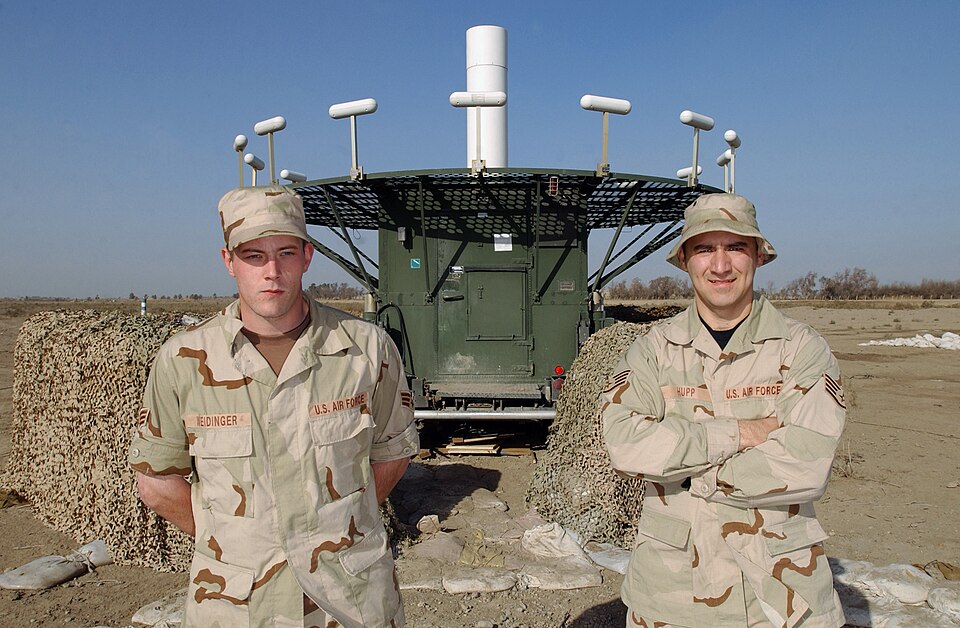
Illustrative photo. Two uniformed technicians stand before a raised circular antenna ring and a green equipment shelter. Navigation services depend on ground equipment and the specialists who maintain it, not only on instruments carried aboard aircraft.
Illustrative role/sector context. This does not depict or verify the employers, vacancies, qualifications or countries discussed below.
Actual employer examples — keep each country and notice separate
Essential, desirable and other conditions retain the author’s source classification. An empty category means no separate requirement was established in the reviewed source, not that employers have no requirements. Historical or closed notices are examples, not current vacancies.
[EMP1] Airservices Australia — Technical Officer (Radio), job 502896
Explicit essential and desirable headings; 'successful applicant will have' and security section add mandatory conditions.
Employer essential requirements
Diploma in Electronics and Communications Engineering or equivalent; current Australian driver licence.
Australian citizenship because the vacancy requires AGSVA security clearance.
Teamwork, planning and ability to develop relevant procedural and equipment knowledge.
Employer desirable requirements
ACMA cabler registration, First Aid/CPR and restricted electrical licence.
Other stated conditions
Darwin-based with remote travel. Radio-navigation equipment expressly includes NDB, DME, VOR and ILS alongside communications and networking.
Duties supported by this example
Maintenance, installations and accurate maintenance records.
This specific employer example is not a worldwide entry rule. A closed or undated example is not an invitation to apply.
Official legal, licensing and occupational context
Employer preferences are not automatically law. Official guidance and occupational descriptions are not necessarily binding rules. Each source’s jurisdiction, scope and gaps below remain separate.
Australia — provider technical personnel
CASA Part 171 addresses technician qualifications and competence. Academic eligibility is separate from specialised training and provider-controlled technical authority.
September 2024 guidance, section 4.3 on technicians.
Limitations
Advisory guidance must be read with current regulations, standards and applicable provider authorisations.
Unresolved research and applicability
Only one specific employer example has been verified. National equivalence decisions and individual task authorisations are outside this guide.
Explore a possible entry route
Start with electrical/electronic fundamentals, mathematics and careful technical documentation. When evaluating a diploma or equivalent qualification, compare its content with the exact employer specification rather than trusting an aviation-sounding course name.
Identify whether the vacancy is a trainee post, a qualified technical entry post or an experienced equipment specialist role. EMP1 expects a diploma but also describes developing equipment knowledge; it is not evidence that every applicant already holds every equipment authorisation.
Ask a prospective training provider to explain which recognised academic award it delivers, and ask an employer separately which local equipment training and competence assessment follow recruitment. A course certificate and operational permission are different things.
Make a practical constraints checklist covering field travel, workplace arrangements and transport requirements, using only your own preferences. Do not disclose medical or identity information to unverified course marketers.
Learning exercises — not proof of professional competence
Build a low-voltage, non-radio-transmitting classroom circuit or simulation and keep a fault-finding log. Record the symptom, safe observations, hypothesis, test result and limits of your conclusion; do not use live navigation equipment.
Create a fictional asset record with an identifier, version, maintenance history and unresolved issue. The objective is accurate, auditable writing, not learning real navigation-aid calibration or maintenance procedures.
Use a public glossary to distinguish a navigation aid from the navigation information given to a pilot. Explain why technical service availability matters without advising anyone how to navigate or fly.
Preparation prompts — not reported interview questions
Prepare a genuine example of following a procedure when a shortcut looked faster. Explain how you checked your scope, raised uncertainty and documented the outcome.
Ask how supervised training, assessment, remote-site work and continuing competence are organised. Clarify whether an advertised driving or electrical credential is needed at application or can be obtained later; never assume.
Progression to investigate
Related directions include equipment specialisation, technical watch, asset management or training. Moving between them depends on the employer and demonstrated competence, not simply time served.
Scope and review limits
Educational requirements guide, not operational instructions, professional approval or an employment guarantee. Educational reference — verify current requirements with the relevant authority.
Examples are selective, dated and job-specific. Check the complete current vacancy and relevant authority before choosing paid training or assessing eligibility. No personal medical, nationality or immigration assessment is made here.
AI-assisted educational preparation. Source availability and hiring conditions can change. No personal data is collected, no application is sent, and no employment or eligibility outcome is promised.